


What Is a TXID? How to Find and Check a Transaction Hash
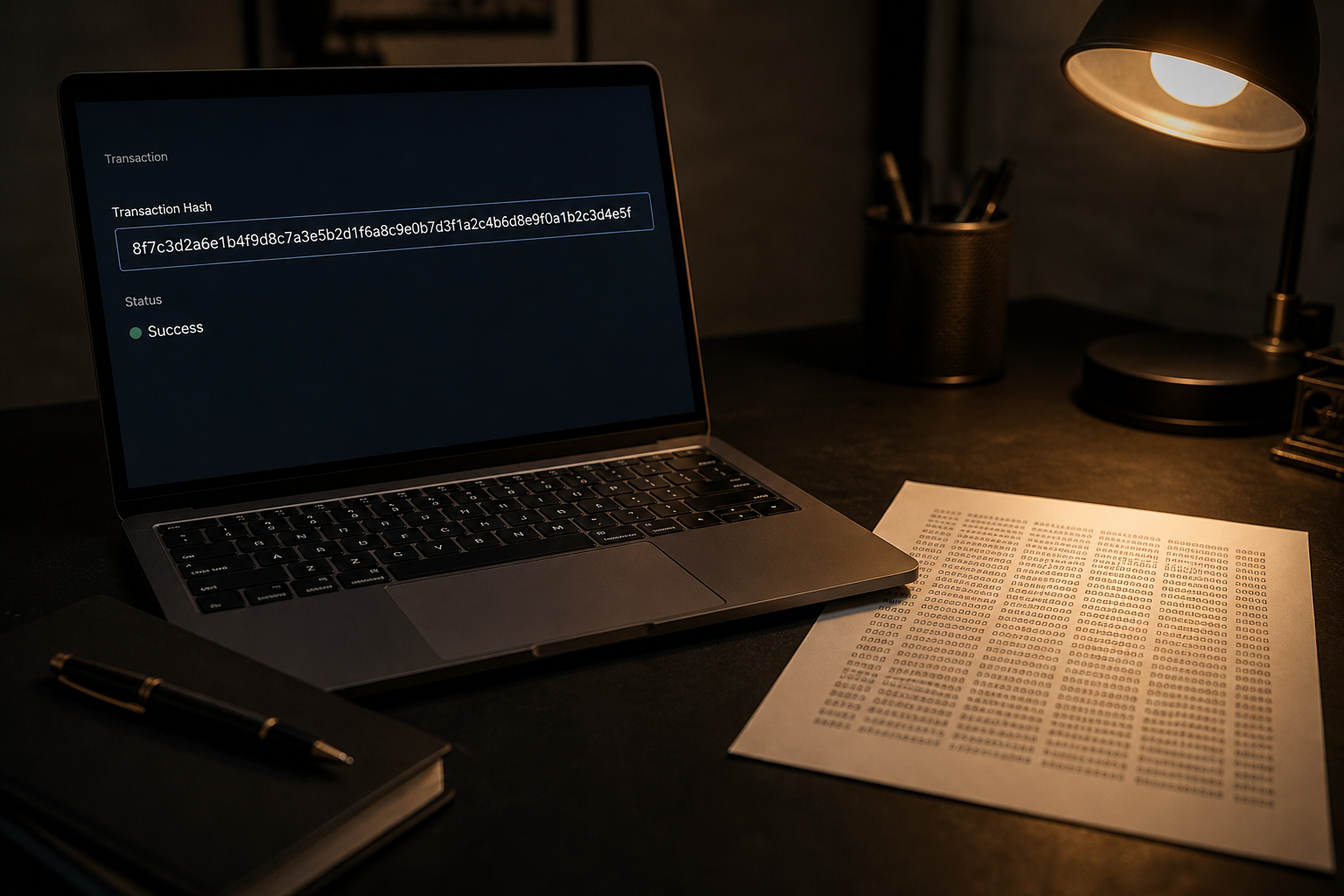
A TxID or transaction hash is the on-chain equivalent of a transfer receipt: a unique hash that a block explorer or an exchange support team uses to locate a specific transaction. Without it, an inquiry about a “missing” deposit or withdrawal will often stall. Preserve the complete hash together with the network (BTC, ETH/ERC-20, or TRON/TRC-20), amount, and time; then check it in an explorer or request blockchain analytics.
TxID and transaction hash: one receipt, different labels
In practice, a TxID or transaction hash is a unique identifier for a transaction on a public blockchain. Technically, it is a cryptographic hash of transaction data. Bitcoin interfaces usually call it a TxID, while Ethereum and EVM networks use Transaction Hash or TxHash. Exchange interfaces may show “TxID,” “Hash,” or “TX.” These labels serve the same purpose: the string points to one specific transfer.
A hash can be calculated before a transaction is broadcast. It alone proves neither broadcast, confirmation nor exchange crediting. Find the transaction on the correct network and check block inclusion; on Ethereum also check execution success. An exchange’s internal withdrawal ID belongs in a platform support request, not in place of a TxID in a blockchain explorer.
A TxID exists only for an actual on-chain transaction, such as an external deposit or withdrawal. Internal transfers between exchange subaccounts, P2P trades within a platform, and derivatives operations often have no blockchain hash. Support then searches by an order or transaction ID in its own system.
What a hash looks like—and what it is not
| Network | Typical format |
|---|---|
| Bitcoin | 64 hexadecimal characters without a prefix |
| Ethereum / EVM | `0x` + 64 hexadecimal characters (66 total) |
| TRON | Usually 64 hexadecimal characters without `0x` |
| Solana | Base58 and longer; do not confuse it with an address |
An address is not a TxID. A Bitcoin address is shorter and often begins with `1`, `3`, or `bc1`. An Ethereum address is `0x` plus 40 hexadecimal characters, while a transaction hash is `0x` plus 64. Use the Copy button to copy the entire string: one extra space or a truncated ending can cause an explorer to report that the transaction was not found.
USDT and other tokens operate on multiple networks, so the same ticker produces different TxIDs on TRC-20, ERC-20, and BEP-20. Always include the network beside the hash in a support request. For the next steps in following a USDT transaction, see how to trace a USDT transaction.
Checklist: where to find a TxID and what to preserve
- Sending exchange: Wallet / Assets → Withdrawal History → transaction details → TxID / TxHash → Copy.
- Receiving exchange: Deposit History—the hash may appear after the first network confirmations; while the status is “processing,” the field may be empty.
- Wallet (MetaMask, Trust Wallet, Ledger Live, and others): Activity / Operations → transaction → Transaction Hash or “View on explorer.”
- If you have an address but no hash, open the network's explorer, locate the outgoing transfer by amount and time, and copy the TxID from the transaction page.
- Preserve a package containing the full TxID, network, amount, From and To addresses, block time, explorer-page URL, and a screenshot of the status.
- Paste the hash into the support request as text, not only as a screenshot.
- Do not select the wrong deposit network.
- Do not expect a hash for an internal exchange operation with no on-chain transaction.
- Do not submit a truncated string.
- Do not search Etherscan for a TRC-20 transfer.
If stolen or mistakenly transferred assets may still be held at an exchange, also consider the emergency response window. A TxID is the starting point, not the conclusion. For help interpreting an explorer page, see the blockchain explorer guide.
Public example: reading a Bitcoin transaction
This is an educational example from the public blockchain, not a client case: transaction f4184fc596403b9d638783cf57adfe4c75c605f6356fbc91338530e9831e9e16. The Blockstream Explorer link is listed in the sources. Select Bitcoin and search for the complete hash.
| Field | Value and meaning |
|---|---|
| TXID | The hash above identifies the entire transaction |
| Block height | 170: the transaction was included in this block |
| Input | One previous output worth 50 BTC was spent |
| Outputs | Two outputs were created: 10 BTC and 40 BTC |
| Fee | 0 BTC: the difference between inputs and outputs in this historical example |
The 40 BTC output uses the same public key as the spent output, consistent with change returning to the sender. Do not automatically treat all outputs as a payment to one recipient. This transaction uses the older P2PK format, so an ordinary address field may be absent from the API. Its zero fee is not a recommendation for a new transfer.
Why support and analysts need the hash
For an exchange support team, the TxID is the primary key used to compare an on-chain transaction with the internal deposit address, confirmation count, and reason the deposit was not credited. Without the hash, an operator has to search among thousands of incoming transfers using only an amount and time. Requests without a TxID are therefore often returned with a request to provide the transaction hash.
For an investigation into theft or a disputed transfer, the hash is an entry point into a transaction graph: From → To → subsequent hops. A public explorer shows addresses and amounts but does not identify the owner by name. Mapping the movement, attributing an exchange, and preparing an evidence package are part of blockchain analytics: you provide the TxID and facts and receive an analysis, not a promise of recovery.
A counterparty refusing to provide a TxID after saying “I already sent it” is a warning sign. A legitimate sender can copy the hash quickly. Never enter your seed phrase or give remote access to services claiming they can “find the transfer from a screenshot.”
For a transaction assessment, supply the TxID, network, expected recipient and the discrepancy: amount, address or crediting. A specialist can compare the blockchain record with exchange history and identify the facts support needs.
Risks and limitations
- A TxID does not guarantee that an exchange will credit the deposit, and it does not make the transfer reversible.
- A wrong network or truncated hash may cause a false “not found” result and prevent support from investigating.
- Internal exchange operations often have no blockchain TxID; this does not mean the transaction disappeared on-chain.
- Labels and statuses in third-party services may lag behind the network's actual confirmation state.
- A TxID and transaction map do not reveal the identity of an address owner or guarantee a freeze or recovery.