


How to trace a scammer's crypto wallet
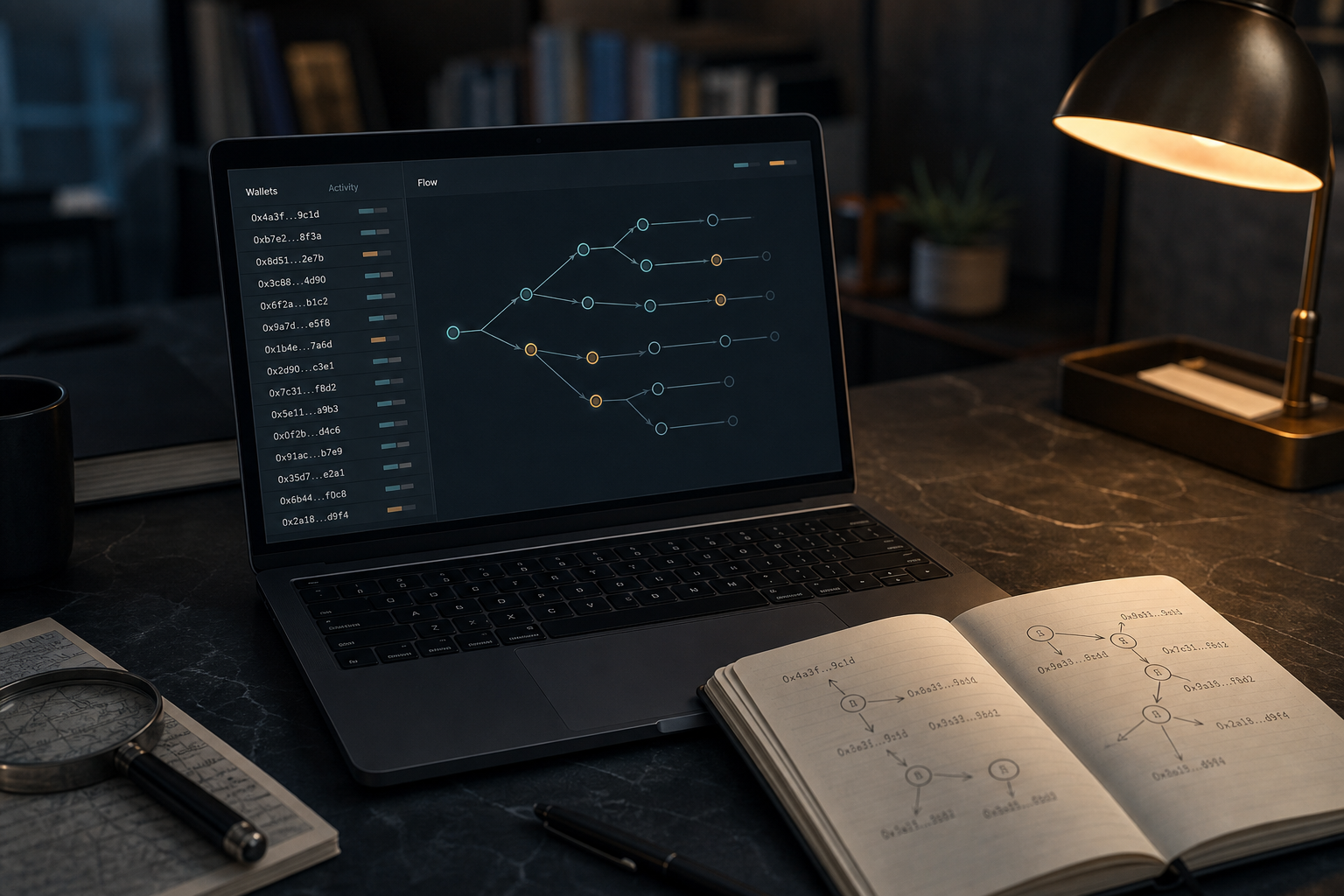
To trace a scammer's wallet yourself, record the address and TxID, follow the public hops in a blockchain explorer, and determine whether the assets moved onward or appear to have reached an exchange deposit address. A blockchain does not reveal a person's name or guarantee a freeze or recovery. When the trail branches, service attribution and a transaction map for the platform require blockchain analytics, not endless explorer browsing.
What "tracing a scammer wallet" actually means
People searching for "how to trace a scammer wallet" usually expect either the address owner's name or a button that returns their money. A public ledger provides something else: a pseudonymous address, amounts, timestamps, and subsequent transfers. A scammer wallet is the address, or cluster of addresses, that received your transfer or assets taken in a scam. The on-chain trail shows asset movement, not a passport or a legal finding.
Manual analysis can establish an initial picture: the network, token contract, From and To fields, one to three hops, and a working hypothesis such as a personal wallet, an OTC service, or an exchange deposit. Full tracing with attribution of exchanges and bridges and a documented report is a separate blockchain analytics service. If the transfer involved USDT specifically, see how to trace a USDT transaction.
A "scammer wallet" is also different from "dirty crypto" in your balance. If you are screening an address before depositing to an exchange, that is risk screening rather than tracing a scam. See how to check crypto for AML risk.
First steps: a blockchain explorer checklist
- Record the network and TxID of the outgoing transfer, or the incoming transfer to the scammer's address if a counterparty supplied the TxID.
- Open the correct network explorer: Tronscan for TRON, Etherscan for Ethereum, or the relevant explorer for Bitcoin and other networks. Do not mix networks.
- On the TxID page, verify the status (confirmed or success), amount, From and To addresses, and canonical token contract rather than a fake token with the same ticker.
- Open the recipient address and review token transfers or TRC-20 Transfers, not only native-asset transfers.
- Save screenshots of the TxID, address, block time, and page URL.
- Follow one to three outgoing transfers from that address until the amount splits, reaches a large hot wallet, or enters a bridge or mixer.
The table below lists common mistakes. If the assets may still be at an exchange deposit address, speed matters: the window for contacting the platform may be shorter than it appears. Assessing the route and preparing a platform-ready evidence package is part of blockchain analytics, not just sending another screenshot to support.
| Mistake | Why it matters |
|---|---|
| Using an explorer for the wrong network | Creates a false picture: an empty address or the wrong transfer |
| Trusting an Exchange label without verification | Can suggest a false exchange entry or hide a real deposit |
| Looking for an owner from the balance alone | Misses the chain of outgoing hops |
| Following dozens of hops manually | Uses up the response window while assets may leave the exchange |
What the analysis can and cannot show
It can show that a transfer occurred, the next hop, and sometimes signs of an exchange deposit: many incoming transfers of different amounts, rapid onward movement within a cluster, or an explorer label. Labels may be missing or inaccurate, and the absence of a tag does not mean "not an exchange." The analysis can also reveal a dead end, such as splitting across many addresses, a mixer, or a cross-chain move without a clear exit. A public explorer records the movement but does not create a point of intervention.
It cannot reveal a person's name, IP address, Telegram account, or who controls the wallet. It cannot freeze an exchange balance or return assets by itself. A freeze is a platform process involving a request, evidence, and sometimes a law-enforcement channel. Finding a deposit address is only the start of that process.
| Goal | Realistic without specialist tools |
|---|---|
| Map one to three hops | Yes, in a public explorer |
| Form a hypothesis that assets entered an exchange | Sometimes, from labels and transaction patterns |
| Identify the address owner by name | No |
| Freeze or recover all assets | Not guaranteed; depends on the platform and transaction trail |
Where manual tracing should stop
- Stop mapping once the TxID and nearest hops are documented.
- Stop when you see a likely exchange entry or a clear dead end such as a mixer, extended splitting, or a bridge.
- Do not click random addresses just in case. This rarely adds clarity and uses up the response window.
- Do not prepay anyone who promises to return everything from a wallet address, and never provide a seed phrase or remote access.
Escalation makes sense when you need service attribution, cross-chain analysis, or a report for lawyers and the platform. With blockchain analytics, you provide addresses and TxIDs and receive a transaction map and material for the next steps, without a promise of recovery based on a screenshot. If the matter proceeds beyond tracing into case support, review the success-fee model. A manual first pass is useful; endless explorer browsing is not a substitute for a documented analysis.
Risks and limitations
- A public explorer does not reveal the identity of a scammer wallet's owner or guarantee recovery.
- Exchange and third-party service labels may be inaccurate or outdated.
- Once assets leave an exchange deposit address, a freeze may no longer be possible.
- Services that promise recovery from an address while requesting an upfront payment, seed phrase, or remote access are a common scam pattern.
- Using the wrong network or a fake token with the same ticker creates a false transaction trail.
Sources used
- Tronscan — TRON blockchain explorer (address / TxID / TRC-20)
- Etherscan — Ethereum blockchain explorer (address / TxID / token transfers)
- Chainalysis — What Is Blockchain Forensics? (tracing flows / attribution limits)
- DefCrypt blockchain analytics practice (manual first pass vs. full analysis, anonymized)