


The Support Ticket Says “Dangerous Transaction”: What Does It Mean?
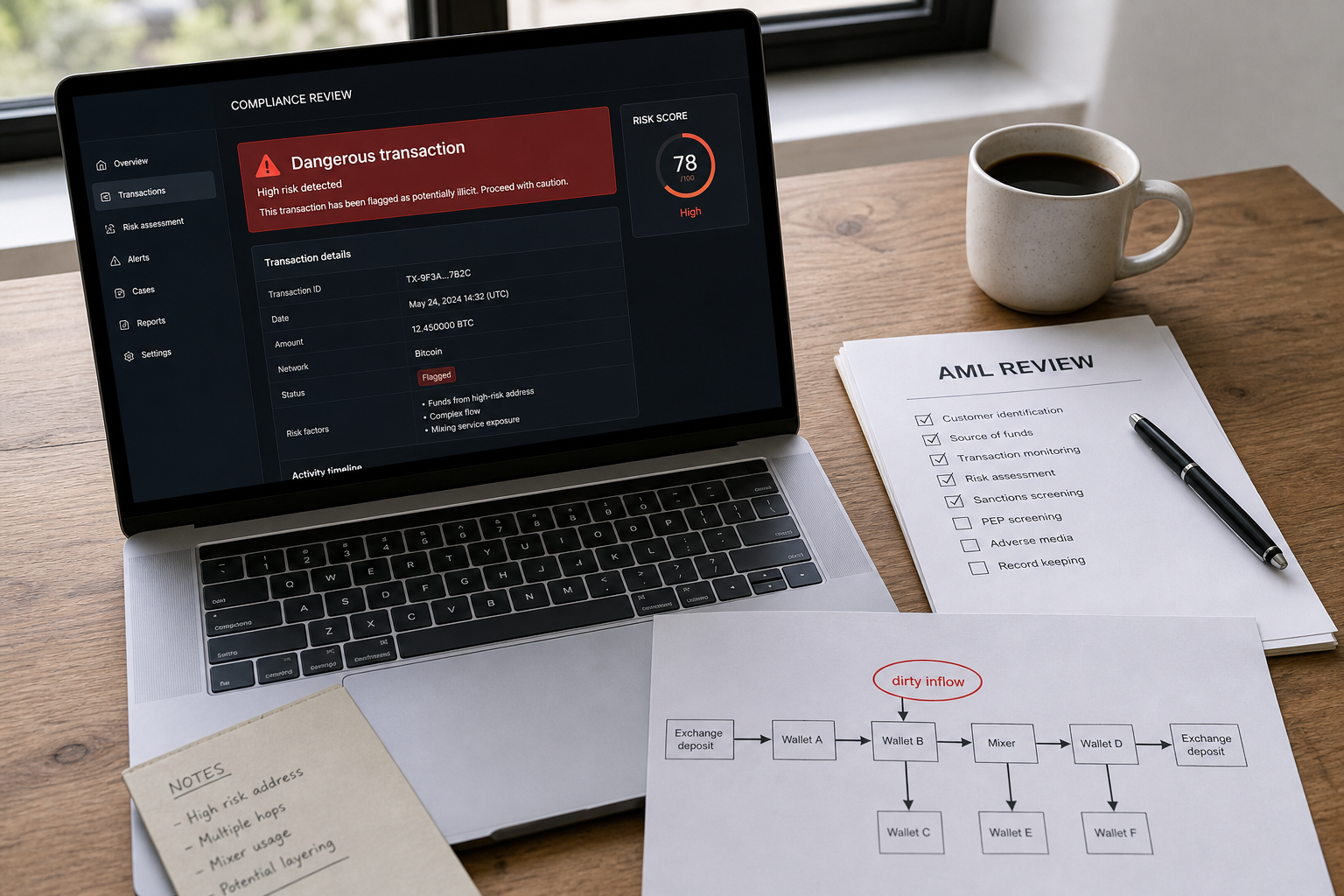
A Dangerous transaction label in an exchange ticket usually means that the system detected elevated risk associated with an address, incoming deposit, or transaction pattern and paused a withdrawal, deposit, or account. It is not a verdict or a different type of coin; it usually reflects a risk assessment of the incoming transaction chain. For context, see what AML means in crypto. If the restriction prevents withdrawals, see exchange account unfreezing.
What the label in a support ticket means
An exchange may use the term Dangerous transaction when its internal monitoring marks a transaction or related address as high risk, often using analytics from vendors such as Chainalysis, TRM, or Elliptic. Other labels may appear in the message, but the general meaning is the same: an automated flag pending manual risk review, not a court judgment.
The flag may concern an incoming deposit and the sender's history, a withdrawal to an external address, or a rapid deposit-to-withdrawal pattern. Exchanges rarely disclose the vendor's exact label. Instead, you see the consequence: a rejected withdrawal, frozen funds, or a document request. For broader guidance, see frozen crypto: what to do.
KYC answers "Who are you?" A Dangerous transaction label more often concerns the assets and their blockchain path. Until the exchange sends a document or Source of Funds (SoF) request, do not infer the reason from online chats. Use the account status and ticket wording. See what dirty crypto means for basic terminology around asset risk.
A high-risk incoming deposit
A high-risk incoming deposit contains assets with a concerning blockchain history, such as exposure to a mixer, scam or theft cluster, sanctioned address, darknet service, or opaque OTC or P2P counterparty. Exposure may be direct, where the sender itself is listed, or indirect across several hops. Both can raise an alert, although the depth of exposure matters to the reviewer.
In practice, you may deposit USDT or BTC as usual and the system flags the incoming TxID. The exchange may then pause only that amount, suspend all withdrawals, or place the entire account under risk review. Mixing a questionable incoming transfer with funds whose source is clear on one address can make the account history harder to explain. Separating addresses before a deposit can reduce this risk.
The exchange may also review the pattern: a large deposit after a long period of inactivity, an immediate withdrawal to a new address, or a chain through small wallets without a clear business purpose. Platform help materials state that when a withdrawal warning appears, it may be appropriate to change the recipient address. Repeated attempts to use the same high-risk address can lead to rejection and additional review.
Checklist: how to respond to support
- Record the exact error or ticket wording, date, amount, network, deposit or withdrawal TxID, sender and recipient addresses, and case number.
- Do not repeat the same transaction dozens of times in the hope that one attempt succeeds; this can strengthen the risk signal.
- Determine whether the issue concerns the recipient address, a high-risk incoming deposit, or a general account hold.
- Prepare one package: a table linking each amount to its source, TxID, and evidence such as a statement, OTC/P2P correspondence identifying the parties, or an account-status screenshot.
- Submit the package through the account's official channel. Never attach a seed phrase or private keys.
Keep the response concise and factual: date, amount, TxID, how the funds were obtained, and a note that supporting files are attached. Ask whether SoF evidence is required for the specific amount. Do not threaten legal action in the first message or open parallel tickets with inconsistent explanations. For the AML layer, see what AML means in crypto. For the first-day process, see frozen crypto: what to do.
First steps when the hold is already active
If only one withdrawal was rejected while trading and other addresses remain available, first check the recipient address. If necessary, withdraw to a verified address you control at another exchange or to a cold wallet without a high-risk history. If all withdrawals or the account are restricted, respond completely to the document request instead of changing your VPN or location or opening a second account.
- Do not try to "clean" the balance through a mixer or unregulated intermediary; AML systems may treat this as concealment.
- Do not pay services that promise guaranteed unfreezing.
- Do not enter a seed phrase into bots or forms found through search.
- Do not open a second account or change your location to another country to bypass the hold.
If the counterparty chain is complex, blockchain analysis may be useful in parallel. For a withdrawal restriction, see exchange account unfreezing. The outcome depends on the platform's policy, the risk-label category, and the quality of the package. Neither the review time nor removal of the flag can be promised in advance. The first steps should reduce avoidable mistakes and give the reviewer a coherent account of the specific amount.
Risks and limitations
- Dangerous transaction is an internal risk-control label used by a particular exchange; wording and thresholds differ between platforms.
- An automated flag is not proof that a transaction was unlawful, but a clean result from a free checker does not override exchange policy.
- Repeated withdrawals to the same high-risk address, a VPN set to another country, and a second account can worsen the risk assessment.
- Using mixers or cleaning services after a flag usually strengthens the AML signal rather than removing it.
- A complete document package and blockchain analysis do not guarantee that the restriction will be lifted or reviewed within a particular timeframe.
Sources used
- Bybit Help — FAQ: On-Chain Crypto Withdrawals (risk warning on withdrawal address)
- Chainalysis — What Is Wallet Screening? (address risk / exposure)
- FATF — Virtual Assets (standards for VA / VASP)
- DefCrypt operational experience with Dangerous transaction labels and high-risk deposits (anonymized)