


How Exchange and Protocol Hacks Are Investigated
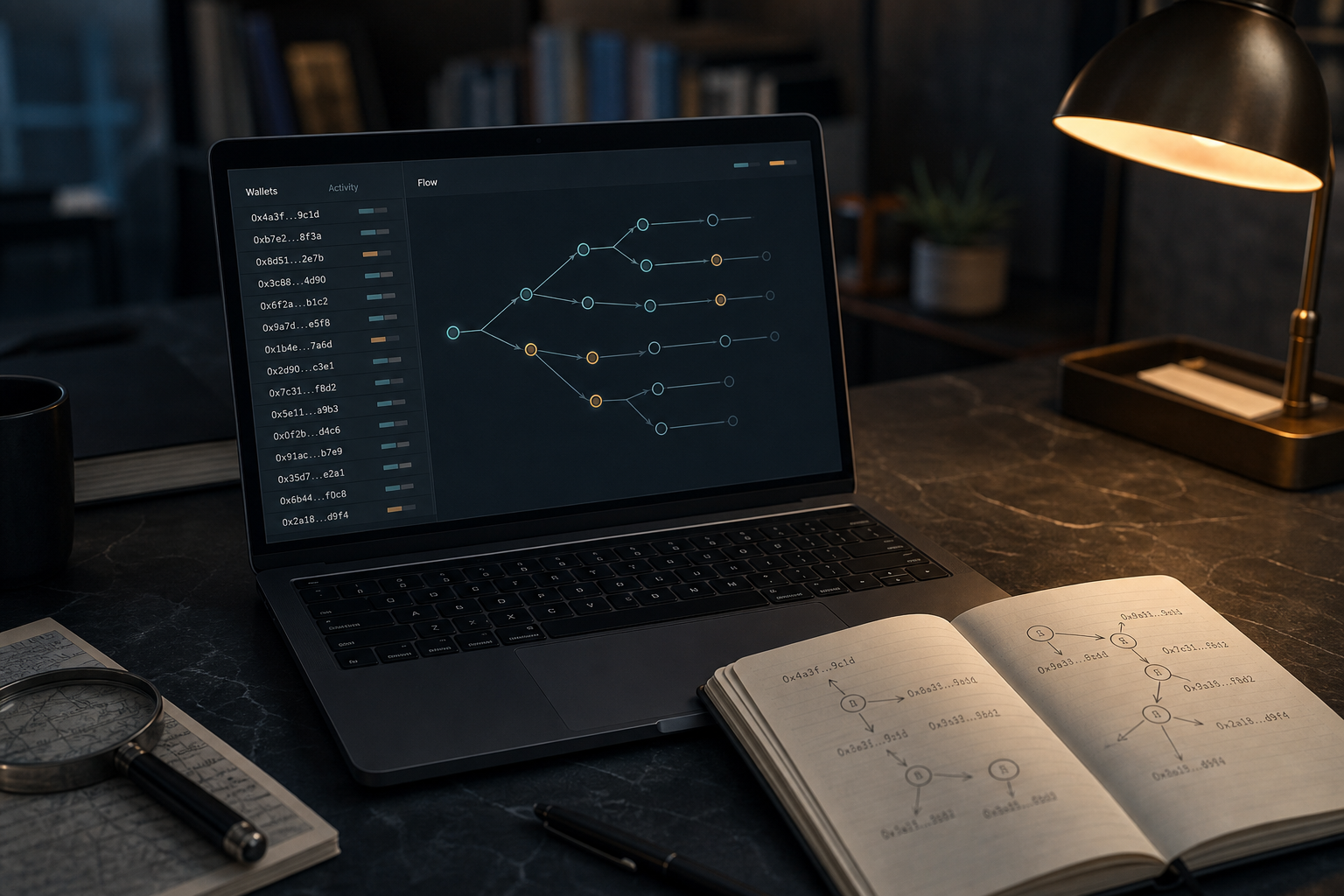
How exchange and protocol hacks are investigated in practice: record the receiving address and TxID, group addresses into clusters, check service labels, and follow bridges until a custodial deposit is a working hypothesis. A public ledger does not reveal a legal name and does not oblige an exchange to freeze a deposit. A self-serve start is the explorer; a coherent map for a platform is blockchain analytics, without a recovery promise.
Where an investigation starts after a hack
A centralized-exchange hack and a DeFi protocol exploit look similar on-chain: a large outgoing transfer (or a series) from a known protocol or cold-wallet address to an address that then splits. The investigation does not start with "the hacker." It starts with facts: network, token contract, TxID, amount, block time, From and To. Until that snapshot is saved, it is easy to argue about a neighbouring transaction from the same minute.
Then comes a graph: each outgoing hop, internal contract transfers, DEX swaps, a move to another network. The goal is not to "unmask a person in the explorer." It is to find a pressure point: a deposit at a regulated platform while the funds are still on its books. How to read transaction fields is in how to read a blockchain explorer. A narrow 1–3 hop walk toward "whose wallet is this" is in how to trace a scammer crypto wallet.
Speed here is about the hold window, not a movie countdown. After a withdrawal from an exchange deposit, a mixer pass, or a long cross-chain route, the pressure point often disappears. A hold request is a separate platform process: see freezing stolen crypto on an exchange. A hop map does not replace that process and does not guarantee it.
Address clustering: turning a pile of 0x… into one wallet
Clustering groups addresses that are likely under one controller. A classic UTXO heuristic (Bitcoin and similar): if several inputs are spent in one transaction, they are often treated as common ownership. Change outputs that return to the sender are another signal. On account-based chains (Ethereum and similar), other patterns matter: a set of addresses funded from one source and emptied in sync; an exchange-deposit pattern (many inbound amounts, then a sweep to a hot wallet).
Attribution is the next layer: match a cluster to a type of entity. An explorer Exchange tag, a public bridge address, a known mixer contract, an OTC pattern. Labels are incomplete and go stale: a missing tag does not mean "not an exchange," and a tag is not a verdict. Checking more than one source reduces false calls, but it still does not produce a legal name for the owner.
| Signal | What investigators do with it | Where it breaks |
|---|---|---|
| Shared UTXO inputs | Cluster as one controller | CoinJoin and joint payments create false merges |
| Sweep to a large hot address | Hypothesis of an exchange deposit | A bridge or OTC hot wallet can look similar |
| Public service label | Platform attribution | The tag is outdated or wrong |
| Amount and time match on a bridge | Link two networks | Delay, fees, and batched mints scramble the pair |
Cross-chain hops and realistic limits of the map
After a large hack, funds often leave for another network: lock-and-mint or burn-and-release on a bridge, a wrapped token, a DEX swap, sometimes a mixer. The trail does not "vanish": the source chain shows a deposit into the bridge contract; the destination shows a mint or unlock. Matching uses amount (minus fees), time, and public message identifiers when the bridge exposes them. That is labour-intensive, not magic.
The limits are honest. Mixers and zero-knowledge pools break a direct A-to-B link: what remains is probabilistic (timing, amount, repeated patterns), not a cinematic identity reveal. False clustering glues together other people's addresses. Long peeling chains of small outputs stretch manual work. The wrong network in the explorer yields an empty picture. A public graph is not a compliance report: a platform needs reproducible TxIDs, not a screenshot of arrows.
Hand the analysis to blockchain analytics when you need service attribution, several networks, and a package for a platform or lawyers. A commercial report is a map and material for next steps, not a freeze promise. If the matter is already a case after that assessment, see the success-fee model.
First steps to record—and where DIY ends
- Save the originating TxID of the hack (or your outgoing transfer if you are a victim, not the protocol), network, token contract, From / To, amount, and UTC time.
- Open the explorer for that network; for tokens, read token transfers, not only native Value.
- Record one to three further outflows until the amount splits, enters a bridge or mixer, or matches a deposit pattern.
- If a bridge contract is visible, open the destination network and look for a mint or unlock of similar size—do not mix networks in one search.
- Screenshot the URL, hash, and addresses; do not paste a seed phrase into advertised "tracers."
- Stop when you have a snapshot and a pressure-point hypothesis—or a clear dead end.
- Do not promise yourself a legal name from an address balance.
- Do not treat an Exchange tag as enough proof for a court or a platform without a second check.
- Do not fire repeat "speed-up" transactions at a bridge contract without understanding status.
- Do not prepay "we recover everything after a protocol hack" for wallet access.
A self-serve explorer covers the first picture. Clustering across hundreds of addresses, cross-chain work, and a platform-ready report are no longer a single transaction page. That is the blockchain analytics contour: you bring hashes and receive a map, with no guarantee that a custodian will still hold—or agree to hold—the deposit.
Risks and limitations
- Clustering and service labels are probabilistic: false merges and stale tags produce the wrong pressure point.
- A public explorer does not reveal identity and does not oblige an exchange to freeze funds.
- After a withdrawal from a deposit, a mixer pass, or a long cross-chain route, the hold window is often closed.
- Prepaid "we recover after a hack" services that ask for a seed phrase or remote access are a common scam.
- A tracing report does not guarantee a freeze, an investigation, or asset recovery.
Sources used
- Chainalysis — What Is Blockchain Forensics? (tracing flows / attribution limits)
- Etherscan Information Center — Understanding an Ethereum Transaction
- ethereum.org — Introduction to blockchain bridges
- DefCrypt blockchain-analytics practice (clustering and cross-chain after a hack, anonymized)