


Stolen USDT: What to Do in the First 24 Hours
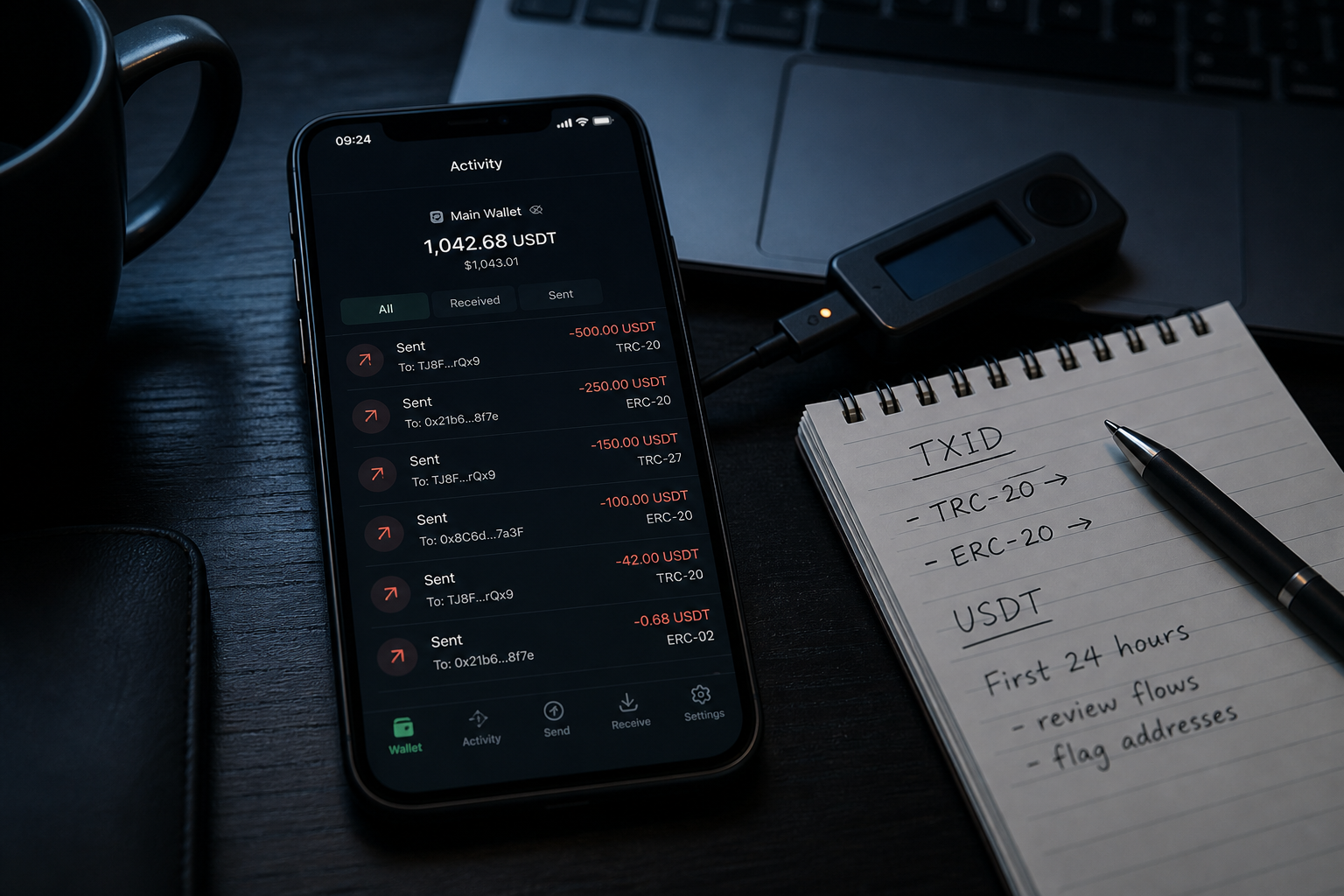
If your USDT was stolen, three actions may still be possible in the first 24 hours: identify the network (TRC-20 or ERC-20) and record the outgoing TxIDs, stop any further outflow from the remaining assets, and submit a freeze request to the platform that received the tokens. Recovery is not guaranteed: an on-chain transfer is irreversible, and a Tether blacklist and an exchange hold are different mechanisms. For a calm response path, see emergency response.
Stolen USDT: what may still be possible in 24 hours
The first-day window matters while the tokens may still be at an exchange deposit address or an intermediate wallet, before an off-ramp through fiat, a mixer, or OTC. During that time, you can compile a complete package—the network, TxIDs, addresses, amounts, and times—move the remaining assets, and report the fraud to the destination platform. A confirmed token transfer cannot be “cancelled”: wallet support, the issuer, and an exchange cannot roll back the blockchain.
USDT is issued on multiple networks. TRC-20 on TRON is common in theft and P2P scenarios; ERC-20 on Ethereum is another frequent route. Confirm the network and canonical token contract first, or a report and any independent tracing may follow the wrong asset. The official USDT TRC-20 contract on TRON is `TR7NHqjeKQxGTCi8q8ZY4pL8otSzgjLj6t`; the ERC-20 contract on Ethereum is `0xdAC17F958D2ee523a2206206994597C13D831ec7`. A token labeled “USDT” under a different contract is a different asset.
For the broader wallet-theft response involving a seed phrase, phishing, or malware, see crypto stolen from a wallet. This article focuses specifically on USDT, the network and TxID package, and the distinction between an “exchange freeze” and an “issuer blacklist.”
First-24-hours checklist
- Record the outgoing TxIDs, network (TRC-20 or ERC-20), From and To addresses, amounts, and UTC times, using both explorer screenshots and a text list.
- Do not delete messages, emails, browser history, or notifications before preserving them.
- Use a clean device to create a new wallet; never enter your seed phrase anywhere else.
- Move the remaining assets, including other USDT and the native gas token, to the new address.
- If the mechanism resembles a malicious approve permission, revoke permissions through a legitimate revocation service whose URL you type manually.
- Change the email password and 2FA for exchanges linked to the same device or phishing incident.
At the same time, open a block explorer and follow the recipient chain for one to three hops. The article on how to trace a USDT transaction explains how to use Tronscan for TRC-20 and Etherscan for ERC-20. If the chain appears to reach an exchange deposit address, do not wait for a complete analysis before preparing the freeze request. The window before an internal withdrawal may be shorter than 24 hours.
- Do not send gas to an address that is already being drained.
- Do not install “USDT recovery bots” or browser extensions found through search results.
- Do not reuse the compromised address for new deposits.
- Do not provide your seed phrase to anyone offering to “unfreeze the channel.”
TxIDs, exchanges, and freeze requests
A package for the destination exchange will usually include your source address, recipient addresses and intermediate hops, the transaction-chain TxIDs, the network and USDT contract, amounts, UTC times, a concise account of how the USDT was stolen, and the steps already taken to protect the remaining assets. A timely, precise package gives a manual risk review a better chance to examine the deposit before it is withdrawn. The platform decides whether to freeze the funds, and there is no guarantee.
| Goal | Realistic action or outcome in the first 24 hours |
|---|---|
| Stop further outflow | New wallet + revoke approvals if needed |
| Preserve the trail | TxIDs, TRC-20/ERC-20 network, addresses, and UTC times |
| Freeze at an exchange | Possible only while the funds remain in the platform account |
| Issuer blacklist | A separate legal process, not a “24-hour support ticket” |
| Recover all funds | Not guaranteed; it depends on the chain and platform |
If the USDT remains at an exchange deposit address or arrived recently, contacting the exchange is a priority alongside moving the remaining assets. If the funds have already moved through a mixer, a long DEX chain, or an OTC off-ramp, the likelihood of a rapid hold decreases. The focus then shifts to tracing and legal options. For a complex chain, blockchain analytics can map transitions and assess service attribution; it cannot promise to “recover everything overnight.”
Do not send a seed phrase, private keys, or complete wallet backups in a support request. The exchange needs evidence of USDT movement and proof of control over the source address according to its procedure—not unrestricted control of your keys.
Issuer vs. exchange: different mechanisms
An exchange freeze is a hold on the platform's custodial account: the deposit is already “inside,” and the platform's risk controls may restrict withdrawals under its fraud-reporting process and rules. See freezing stolen crypto on an exchange for more detail. An issuer blacklist is different: the USDT contract includes functions that can prevent transfers from a specified on-chain address, typically through legal and law-enforcement processes. The article on USDT frozen by the issuer explains how this differs from an exchange AML review.
Confusing these mechanisms wastes time. A message “to Tether” without the TxIDs, network, and legal basis is unlikely to accelerate the first-day response. An exchange report without evidence of the deposit is also incomplete. A realistic first-day goal is: TxID package → destination exchange, if the deposit is visible, plus preservation of evidence for law enforcement and legal counsel. An issuer blacklist is a separate, more demanding process with no promised timeline or outcome. If the matter has become a managed case rather than a checklist, the success-fee model explains one possible engagement structure.
FBI IC3 and similar reporting channels request addresses, transaction hashes, amounts, and times, and warn about up-front-fee “recovery” schemes. Confirm the reporting procedure in your jurisdiction; filing a report does not by itself return USDT transferred on-chain.
Risks and limitations
- A confirmed USDT transfer is irreversible; recovery is not guaranteed.
- Using the wrong network (TRC-20 vs. ERC-20) or a fake “USDT” contract may invalidate the report and tracing effort.
- An exchange decides whether to freeze funds, and the window before withdrawal may close within hours.
- An issuer blacklist is not the same as a routine support request and does not promise an “unfreeze within 24 hours.”
- Services claiming they can “recover USDT from a TxID” while requesting a seed phrase or remote access are a common secondary fraud.
Sources used
- FBI IC3 — Cryptocurrency: what to report after theft or scam (addresses, transaction hashes, amounts, and times)
- Tether Relevant Information Document — freeze of tokens in external wallets at the behest of law enforcement
- Etherscan — Tether USD (USDT) ERC-20 token 0xdAC17F958D2ee523a2206206994597C13D831ec7
- Tronscan — TRON blockchain explorer (TRC-20 / TxID)
- DefCrypt emergency-response practice for USDT theft in the first 24 hours (anonymized)